What does it take to go from wholly mediocre to number one in the country in 18 months? Practices involving a combination of small-group passing, field tactics, defense, throw-ins, corner kicks, and, most importantly, open-play scrimmages? Oh wait, no, sorry—that’s what every other coach in the country does to waste their hour and a half.
The secret is individual development pushed to the absolute maximum. What I call “the race to one million touches.” My daughter was fortunate enough to drop in on a few practices with that team this year, and she got more touches in those single sessions than she would with her own team in an entire month. This is not an indictment on our club, which is as good or better than other top clubs at winning the race to a million touches, but a testament to how focused this particular team is at the race.
The skills were complex, pro-level moves, but largely the same. Focused repetition was key. Stretching and warm-up happened before practice. At 6:00 sharp, the coach would call out, “Rollover, rollover, double scissors, double stepover, L-turn, rollover, rollover, double scissors, pass. Switch.” All the kids immediately knew what this meant and began. After 10 minutes: “L-cut, L-cut, rollover, rollover. L-cut, L-cut, L-cut. Switch feet on the way back. Go.” Those unfamiliar, like my daughter, learned by watching and doing their best. They repeated these moves until they could do them in their sleep. And then they did them some more. Practices ended with 30 minutes of no-goal possession drills with three teams. Two hours, four days a week. In 18 months, he had the most skilled team in the nation.
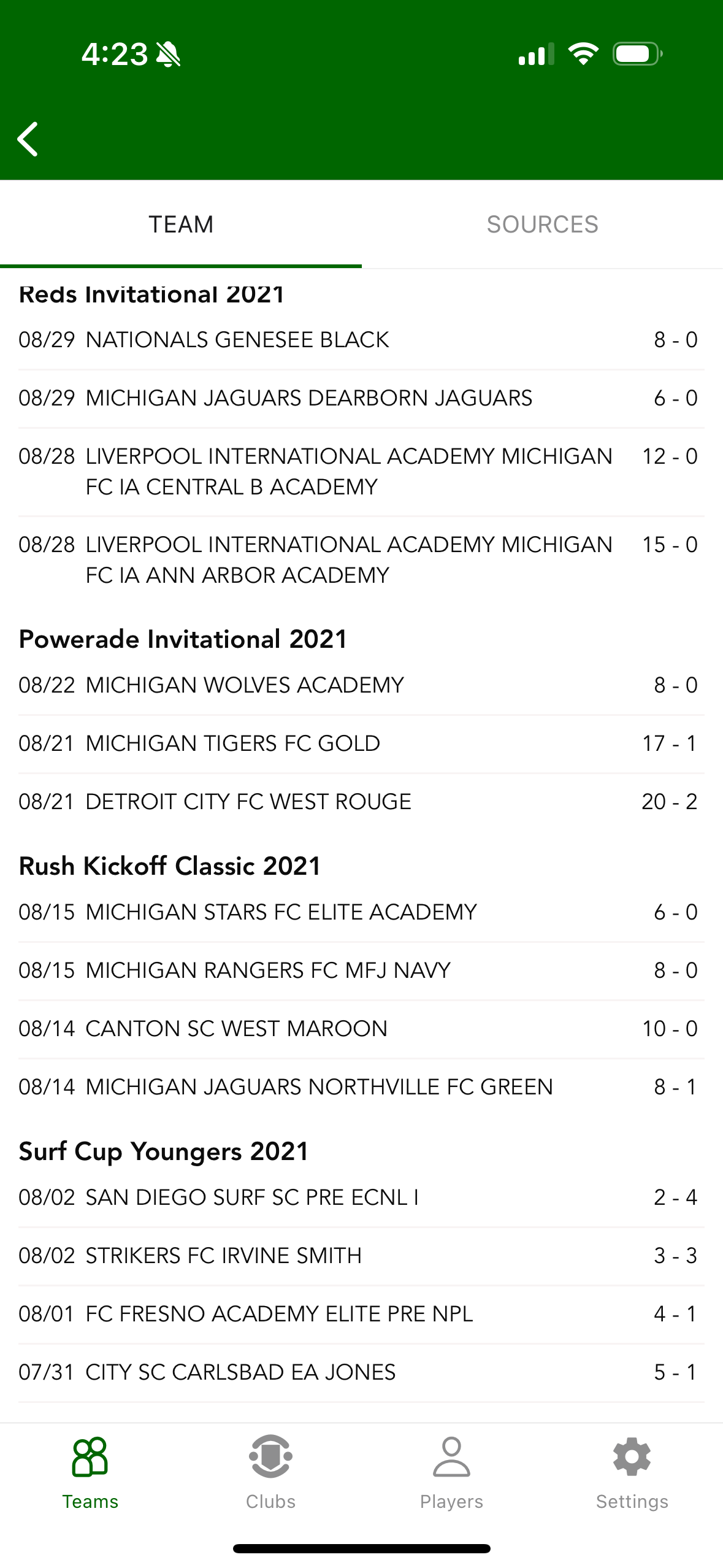
**The Surf Cup loss was essentially a national championship – that team is currently number 2 in the nation and while I’m not certain likely a San Diego All-Star team and the host of that tournament. The teams in Michigan are the top clubs in the area just to illustrate the separation.**
In all honesty, the practices weren’t the most fun. The coach could likely gamify them to make them more enjoyable and maybe he does, I wouldn’t know. However, I know he did set the standard right away. He promised national excellence and Division I college-level skills at the cost of hard work. I’m sure the kids complained at times—but that happens at all top levels in every sport. The parents didn’t have to pay for private sessions at $50 per hour, as many other elite players do, to keep up their skills outside of their club and the kids results were immediate.
Pretty much every coach in the area has heard of this team’s story and their rapid rise to the top. The coach is quite polarizing and maybe even abrasive, so in my opinion people look for any chance to discredit him. It still astonishes me that no other coach or club has decided to replicate his blueprint.
One crucial point in defense of the coaches is that they are fighting an uphill battle with these effective practices. Most parents don’t want long practices of “boring,” technical drills. Many kids don’t want that either. Not everyone is that serious about the sport. It’s a big risk to take as a coach to step way out of the box. Our club has a technical training day in the realm of this type of effective practice, but it’s not nearly technical, long, or repetitive enough. The repetitive part probably being the most important. “Fear not the man that has done 10,000 kicks once, but the man that has done 1 kick 10,000 times.” There are a few teams that could get over the hump so easily by really buckling down on the technical side and it’s just curious that it never happens.
Lastly, some coaches will say, “It’s the players’ job to improve individually outside of practice; my job is to coach the team.” That might fly in college, its unrealistic at the youth level. If you are going to do that, you need to make sure that the work is getting done otherwise you are trying to learn algebra without first mastering basic arithmetic. Even dedicating the first 30 minutes of each practice to repetitive technical drills would yield significant results and minimize backlash. The last hurdle coaches face (and a reason I will likely never coach) is that you are limited to two-year team limits in most major clubs. So, you would be putting in all the risky, hard work, only for another coach to reap the benefits of coaching a technically sound team.
Coaching Red Flags:
I’ve observed many coaches in various sports as a player and a parent. I was even a subpar AYSO coach myself on multiple occasions. My daughter has had coaches who also coach high school and college teams, some who have won state and national championships, one who was a professional in Germany, some whose children have gone pro, and some who were just starting out. They all had their strengths, but they also made some mistakes that hindered individual skill development.
I believe most coaches fail this coaching test: “Would my team have been better off spending an hour kicking a ball against a wall instead of doing what I planned for today?” Very few practices can pass this test. Having a good first touch, accurate passing, and effective dribbling are fundamental skills, akin to learning addition, subtraction, multiplication, and division in mathematics. You cannot teach algebra until you understand 8 x 4 = 32. Yet, that’s essentially what many soccer coaches do. The same teams struggle with the same issues year after year.
On my way to my kids’ practice area, I pass by all the young children at our club, learning the game. I enjoy watching them play. I’m a big fan of the coach of this age group at our club. He puts tremendous effort into every training session. He’s enthusiastic about teaching soccer every day, which I respect. His energetic and demanding coaching style is the right approach. Watching him encourage the young players brings me great joy. It’s evident that they enjoy playing for him and respect him. One of my friends, whose child is on the team, said, “In two years, the kids have never done the same drill twice! Isn’t that great?” While I didn’t have time to fully explain my coaching philosophy, that statement is actually counterproductive. The coach expends a great deal of effort preparing new drills for each practice, and it’s a testament to his dedication. However, it’s ultimately detrimental to the players’ development. Imagine a group of six-year-olds with poles, cones, and various groups, but everything is new to both the coach and the players each time. Five minutes to set up. Five minutes to explain it. Five minutes to watch them fumble through the drill. Five minutes of them doing it somewhat correctly, just in time for the next drill, which requires another round of explanation. This coach is losing the race to one million touches.
Other phrases you don’t want to hear from your coach:
- “We focus on development here. It’s not about winning at this age.” This is often a euphemism for “Don’t get mad at me if we lose.”
- “I like to let the players figure it out.” This statement infuriates me. Kids need to hear the same lessons repeatedly. That’s the coach’s job. I’ve explained one forward positioning tactic to my daughter at least 50 times, and she still makes the same mistakes. The idea that kids will learn the game on their own like Galileo staring at the sun is absurd.
- “We play out of the back, while the other team just plays kickball. That’s why they win.” Even Premier League teams struggle to play out of the back against high-pressing opponents. You can play skillful soccer without conceding goals in your own third in the name of development. Furthermore, I’ve never seen a team successfully play out of the back against another top team until the 11v11 level. You can play out of the back against teams that you are much better than, I’d argue that doesn’t prove or help anything.
 justinsadauskas
Leave a comment