My biggest passion in life ignited when I first discovered poker around 1999-2000 and than the message board twoplustwo.com where I was able trade strategy ideas with others. Poker strategy utterly consumed my thoughts for many years. The feeling of finding something you love deeply, something you can even make money from was truly a blessing. While I enjoy real estate investing, it doesn’t compare. Other passions include golf, the computer game StarCraft, and chess. However, youth sports have now surpassed them all except poker.
I played year-round soccer with top clubs, alongside travel basketball, baseball, and scholastic chess. I even squeezed in junior golf during summers. I loved every bit of it. My dad coached me very hard and was very involved like I am with my kids. Even thought it didn’t amount to anything passed high school, those are still some of my fondest memories.
I often hear the argument that youth sports “don’t matter.” While I understand the sentiment, I wonder what specifically does matter? Are all children who aren’t involved in sports diligently working on solving the Riemann Hypothesis? I believe sports instill one of the most crucial lessons a parent can teach: improvement is a journey that demands discipline, consistent practice, and a well-defined plan. You get a front row seat to learning what improvement looks like in the real world.
With Lexie and Will, I have the privilege of witnessing some of the best soccer players in the 2011 and 2013 age groups. I’m hoping Will’s passion for golf allows me to watch some exceptional young golfers as well. When I go to trainings, I watch all the players. There’s a girl in Lexie’s age group who I believe has the potential to make the National Team – it’s gonna be great to see if that happens.
The true intrigue for me lies in the experiment of it. Which physical and mental attributes translate most effectively as the athletes mature? Is athleticism paramount? Which traits between, speed, quickness, strength, toughness, matter most? Does individual work ethic just reign supreme? The ones that care the most get the furthest? Can players who start late or get behind catch up to the top level in technical skill? After guiding my own children through this experience and watching their peers grow, I’m confident I’ll gain invaluable insights into effective training methods and identify what the secret sauce looks like.
Who knows, perhaps after my children have grown, I’ll find a way to sustain and/or monetize my passion and hopefully my insight for youth sports. Beyond winning the lottery and establishing my own club and training facility, I haven’t yet devised a concrete plan.
I’m not entirely clear on the specifics surrounding the creation of the new team, but essentially, its core consisted of players who had not been successful on the previous team. This coach also managed to develop a second team, bringing them to the #2 ranking in the state, despite some player overlap between the two teams—a truly impressive feat.
I can offer a specific example: my nephew. He’s a very athletic individual and would likely have been a top player regardless, but his current level of technical skill is so much greater than his peers at other clubs that the training has to have helped immensely. While he primarily plays as a center back, here’s a video of him at age 10 executing a Maradona and finishing with his left foot. You can find 16 yr old MLS NEXT kids that can’t do this.
Addressing the “Plateau” Argument:
Let’s say you were super serious about weight-training and you wanted to get young kids stronger than their competition. You could certainly do that and you’d have a short-term edge, but soccer strength and conditioning has a plateau, becoming Mr. Olympia isn’t going to help you on the pitch. Does ball mastery have a similar plateau? I would argue most definitely not. Ball mastery consistently yields benefits—there’s no point at which becoming more proficient with the ball becomes detrimental or even significantly less useful. In soccer, ball mastery is the very essence of the sport.
What if Players Lack Athleticism?
Soccer demands speed, quickness, and a combination of toughness and strength. While I think you can enhance toughness and strength, significant improvements in speed and quickness are rare.
I believe the coach possesses a keen understanding of which athletic attributes translate most effectively in soccer – he’s probably seen a lot of kids develop – which likely informed his player selection process. Interestingly, the coach’s father son is not particularly athletic. His father knew this when he was very young even when it wasn’t obvious. In the previous videos, he looks faster than everyone. He has an unusual gait that hinders his quickness and speed, and other players have gradually made up the technical gap with superior athleticism in the midfield.
While athleticism is undoubtedly important, it’s crucial to acknowledge that exceptional skill can compensate for certain athletic limitations. There are legendary players that were so skilled that they could overcome huge gaps in athleticism. Again, technique and skill is king and should take up as much of your training as you can stomach.
What does it take to go from wholly mediocre to number one in the country in 18 months? Practices involving a combination of small-group passing, field tactics, defense, throw-ins, corner kicks, and, most importantly, open-play scrimmages? Oh wait, no, sorry—that’s what every other coach in the country does to waste their hour and a half.
The secret is individual development pushed to the absolute maximum. What I call “the race to one million touches.” My daughter was fortunate enough to drop in on a few practices with that team this year, and she got more touches in those single sessions than she would with her own team in an entire month. This is not an indictment on our club, which is as good or better than other top clubs at winning the race to a million touches, but a testament to how focused this particular team is at the race.
The skills were complex, pro-level moves, but largely the same. Focused repetition was key. Stretching and warm-up happened before practice. At 6:00 sharp, the coach would call out, “Rollover, rollover, double scissors, double stepover, L-turn, rollover, rollover, double scissors, pass. Switch.” All the kids immediately knew what this meant and began. After 10 minutes: “L-cut, L-cut, rollover, rollover. L-cut, L-cut, L-cut. Switch feet on the way back. Go.” Those unfamiliar, like my daughter, learned by watching and doing their best. They repeated these moves until they could do them in their sleep. And then they did them some more. Practices ended with 30 minutes of no-goal possession drills with three teams. Two hours, four days a week. In 18 months, he had the most skilled team in the nation.
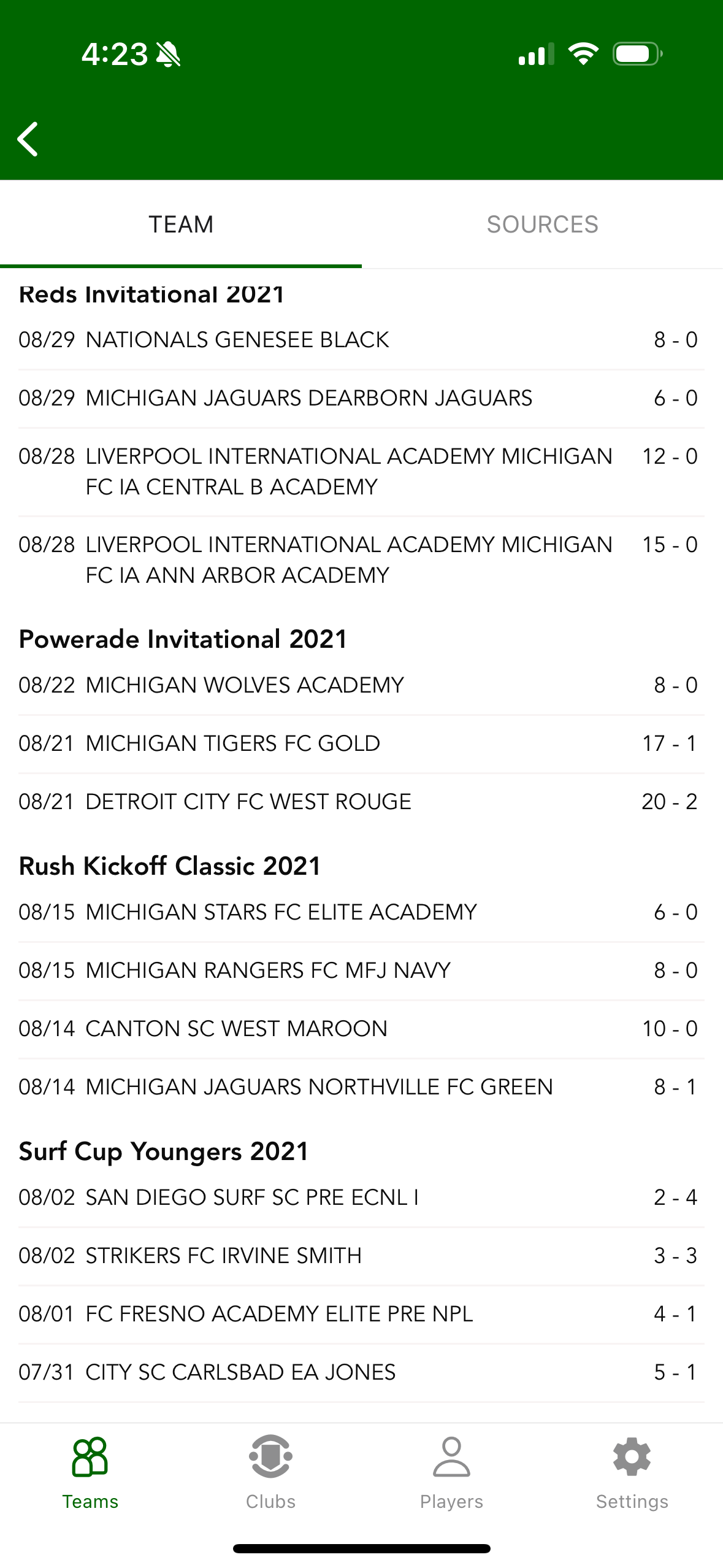
**The Surf Cup loss was essentially a national championship – that team is currently number 2 in the nation and while I’m not certain likely a San Diego All-Star team and the host of that tournament. The teams in Michigan are the top clubs in the area just to illustrate the separation.**
In all honesty, the practices weren’t the most fun. The coach could likely gamify them to make them more enjoyable and maybe he does, I wouldn’t know. However, I know he did set the standard right away. He promised national excellence and Division I college-level skills at the cost of hard work. I’m sure the kids complained at times—but that happens at all top levels in every sport. The parents didn’t have to pay for private sessions at $50 per hour, as many other elite players do, to keep up their skills outside of their club and the kids results were immediate.
Pretty much every coach in the area has heard of this team’s story and their rapid rise to the top. The coach is quite polarizing and maybe even abrasive, so in my opinion people look for any chance to discredit him. It still astonishes me that no other coach or club has decided to replicate his blueprint.
One crucial point in defense of the coaches is that they are fighting an uphill battle with these effective practices. Most parents don’t want long practices of “boring,” technical drills. Many kids don’t want that either. Not everyone is that serious about the sport. It’s a big risk to take as a coach to step way out of the box. Our club has a technical training day in the realm of this type of effective practice, but it’s not nearly technical, long, or repetitive enough. The repetitive part probably being the most important. “Fear not the man that has done 10,000 kicks once, but the man that has done 1 kick 10,000 times.” There are a few teams that could get over the hump so easily by really buckling down on the technical side and it’s just curious that it never happens.
Lastly, some coaches will say, “It’s the players’ job to improve individually outside of practice; my job is to coach the team.” That might fly in college, its unrealistic at the youth level. If you are going to do that, you need to make sure that the work is getting done otherwise you are trying to learn algebra without first mastering basic arithmetic. Even dedicating the first 30 minutes of each practice to repetitive technical drills would yield significant results and minimize backlash. The last hurdle coaches face (and a reason I will likely never coach) is that you are limited to two-year team limits in most major clubs. So, you would be putting in all the risky, hard work, only for another coach to reap the benefits of coaching a technically sound team.
Coaching Red Flags:
I’ve observed many coaches in various sports as a player and a parent. I was even a subpar AYSO coach myself on multiple occasions. My daughter has had coaches who also coach high school and college teams, some who have won state and national championships, one who was a professional in Germany, some whose children have gone pro, and some who were just starting out. They all had their strengths, but they also made some mistakes that hindered individual skill development.
I believe most coaches fail this coaching test: “Would my team have been better off spending an hour kicking a ball against a wall instead of doing what I planned for today?” Very few practices can pass this test. Having a good first touch, accurate passing, and effective dribbling are fundamental skills, akin to learning addition, subtraction, multiplication, and division in mathematics. You cannot teach algebra until you understand 8 x 4 = 32. Yet, that’s essentially what many soccer coaches do. The same teams struggle with the same issues year after year.
On my way to my kids’ practice area, I pass by all the young children at our club, learning the game. I enjoy watching them play. I’m a big fan of the coach of this age group at our club. He puts tremendous effort into every training session. He’s enthusiastic about teaching soccer every day, which I respect. His energetic and demanding coaching style is the right approach. Watching him encourage the young players brings me great joy. It’s evident that they enjoy playing for him and respect him. One of my friends, whose child is on the team, said, “In two years, the kids have never done the same drill twice! Isn’t that great?” While I didn’t have time to fully explain my coaching philosophy, that statement is actually counterproductive. The coach expends a great deal of effort preparing new drills for each practice, and it’s a testament to his dedication. However, it’s ultimately detrimental to the players’ development. Imagine a group of six-year-olds with poles, cones, and various groups, but everything is new to both the coach and the players each time. Five minutes to set up. Five minutes to explain it. Five minutes to watch them fumble through the drill. Five minutes of them doing it somewhat correctly, just in time for the next drill, which requires another round of explanation. This coach is losing the race to one million touches.
Other phrases you don’t want to hear from your coach:
“We focus on development here. It’s not about winning at this age.” This is often a euphemism for “Don’t get mad at me if we lose.”
“I like to let the players figure it out.” This statement infuriates me. Kids need to hear the same lessons repeatedly. That’s the coach’s job. I’ve explained one forward positioning tactic to my daughter at least 50 times, and she still makes the same mistakes. The idea that kids will learn the game on their own like Galileo staring at the sun is absurd.
“We play out of the back, while the other team just plays kickball. That’s why they win.” Even Premier League teams struggle to play out of the back against high-pressing opponents. You can play skillful soccer without conceding goals in your own third in the name of development. Furthermore, I’ve never seen a team successfully play out of the back against another top team until the 11v11 level. You can play out of the back against teams that you are much better than, I’d argue that doesn’t prove or help anything.
This is a real-life, true story of what is possible with great coaching. I feel fortunate to have been close enough to some of the parties involved to understand how the story unfolded. Frankly, knowing what was possible in the right circumstances renewed my passion in youth sports.
The normal path towards travel soccer is AYSO success > kiddie travel club training > travel team. I was in the kiddie travel club stage with either my son or daughter, I don’t quite remember, minding my own business when I see this little mohawked kid that was probably 4 or 5 years old. He was like a kid you would see on Instagram reels from Spain or Brazil. Spectacular technique, stepovers, scissors at full speed, rocket shots with his laces, landing on his shooting foot. Clearly a kid that has spent his short time on Earth playing soccer everyday. I remember thinking, huh, that’s pretty rare. I approached the dad to see what his story was cause I love seeing these type of things, but he wasn’t very interested in any banter. I later found it was his like 7th or 8th kid and one of them was already in the MLS so baby training soccer wasn’t as exciting for him as it was for me.
The prodigal kid signed up for the travel team that was hosting those trainings which happened to have my nephew on the team. They were a new team, they had good players, everyone involved assume they would be a top team. How could they not be? They had a coach that was/is well-respected and still coaches some solid teams. However, they weren’t very good, nowhere near the best team in the state. At one point they were even losing to bridge teams – teams between rec and travel. Totally unacceptable given the talent and amount of training that the travel kids would have over the other non travel kids. It’s like if a G-League team beat an NBA team or something. Even looking back now, the results they had seem impossibly bad knowing how good some of those kids would become.
At some point during the second season, the dad of the prodigal kid gets frustrated. He can’t take it anymore takes 5-6 players off the team adds a few new players and forms his own team. He tells the parents – we are gonna train like crazy, we are gonna travel like crazy, but we’re gonna be really good. If you stick with me they will be choosing their colleges when they are done. Without foreshadowing too much, I remember thinking that was a WILD claim at the time, but also greatly underestimated the commitment that these kids and parents would be taking on.
In 1.5 years they went from like #3000 in the country to the #1 team in the country. In hindsight, the dad/coach probably got lucky with some of the athleticism the kids he brought had (or some very good foresight), but essentially it took 18 months of training for them to go from mediocre in the state to the best team in the country. They held this spot for roughly three years falling at worst falling to at worst around number five. Over that span they were clearly the best team and held number one for the longest periods. In addition, almost all of the top national “teams” are essentially big city All-Star teams. They don’t play or practice together regularly. Miami, Dallas, NY, they just pick their best players and make a “team.” In LA, it’s the Eddie Johnson Academy (former National Team Player), and if your kid is really good you can play in a tournament on their “team.” Those teams never have to worry about not having a good goalie or player injuries like my nephew’s team. They would just send out the bat signal and get the next superstar guest player at any position and not miss a beat. My nephews team was a true team, and they annihilated everyone. Currently in non-gate kept leagues, they are the only team in Michigan in the top 10 nationally – that’s how rare they are.
So, back to coaching: a full-time coach being paid a salary at a top club couldn’t get the same players to top 15 in the state, but in 18 months, a “dad” (I use that term liberally cause he is obviously and amazing coach) was able to take those players to #1 in the country. This is the start of a long point and multiple blogs about how much coaching matters and what good coaching actually means. So what did the dad of the prodigy do differently than everyone else? Stay tuned for part 2!
Video of one the young kid probably right before they started the journey to #1. The competition might look soft but they are super young and this is actually at the biggest tournament in the Midwest.
 justinsadauskas